Field School Movement Boosts Sustainable Farming in Indonesia
The Amartapadi Cooperative is deeply committed to improving the welfare of farmers in Indramayu Regency, West Java, Indonesia. Their efforts focus on establishing seed banks, developing rice breeding programs, and promoting agroecological farming practices. This initiative is supported by the Aliansi Petani Indonesia (API) (Indonesian Peasants’ Alliance) and the APFP-FO4A program.
The Asia-Pacific Farmers’ Program (APFP) – Farmers’ Organizations for Asia (FO4A) is implemented by the Asian Farmers’ Association for Sustainable Rural Development (AFA) and La Via Campesina (LVC), with funding from the European Union (EU) and the International Fund for Agricultural Development (IFAD). The program aims to strengthen the capacities of farmers’ organizations to provide economic services, advocate for enabling policies, and promote sustainable livelihoods for small-scale family farmers across Asia.
“Together with API, we developed the Indonesian Rice Farmers Association, Amartapadi, because Indramayu is known as the rice barn of Indonesia. Most of its people are smallholder rice farmers. We want to strengthen them by building networks at the sub-district level so that they can sustain farming from upstream to downstream,” said Joharipin, Coordinator of Amartapadi Indramayu.
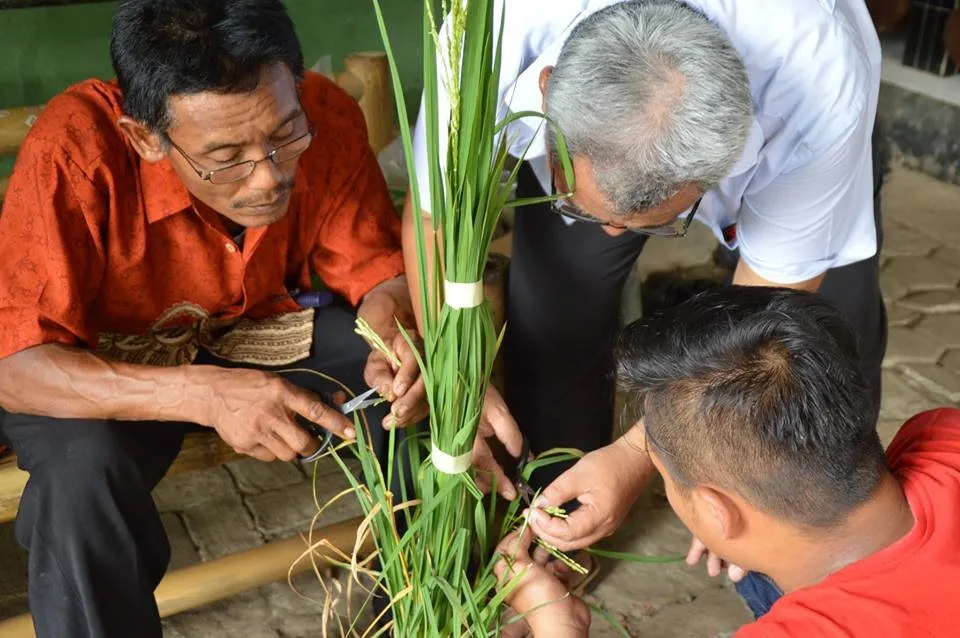
One of the cooperative’s key initiatives is the Field School Movement, designed for rice farmers to enhance their knowledge and practices. Through these sessions, farmers learn every step of rice cultivation, from selecting quality seeds and managing the seeding and planting processes to caring for their crops and harvesting.
“The field school is without walls. It takes place right at the edge of the rice fields. Ideally, it runs for one full growing season. We invite farmers from nearby villages to learn together about agroecology. There are 16 meetings, held once a week,” Joharipin explained.
Looking ahead, Joharidin and the cooperative aim to help farmers establish joint enterprises, allowing them to move beyond production and into processing and marketing. One of their plans is to develop and distribute affordable, healthy rice managed independently by the cooperative.
“We want to provide healthy rice that is affordable for local communities so that people can eat better while farmers receive fair prices. Farmers have long depended on middlemen after harvest. We are working to create new systems where farmer groups can process and market their products collectively,” he added.
However, Joharidin noted that achieving this vision requires continued support and coordination with local governments and other stakeholders, especially in aligning with regional agricultural policies that help sustain smallholder production.
“Amartapadi aims to strengthen farmers’ capacities to manage natural resources wisely, uphold their rights, and improve their livelihoods. We want to see rural farmers’ economies grow stronger while staying true to the principles of API and Amartapadi,” he concluded.
Note: This article is originally published in the Asian Pacific Farmers’ Forum, managed by the Asian Farmers Association (AFA). AFA is one of the steering committee members of ComDev Asia.