Implications of RCS for Digital Farmers Program discussed at Family Farming Dialogue in Nepal
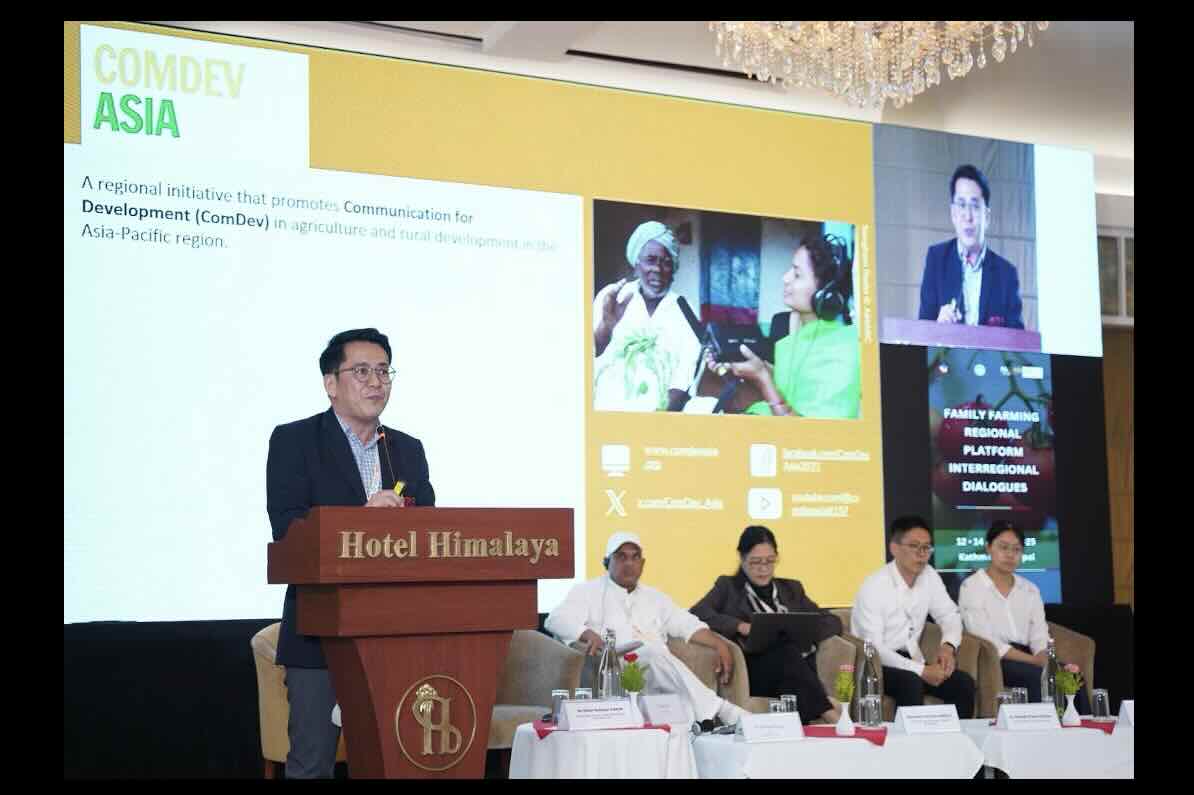
ComDev Asia, represented by Dr. Edmund G. Centeno, Dean of the University of the Philippines College of Development Communication, presented the implications of Rural Communication Services (RCS) for the Digital Farmers’ Program at the Family Farming Regional Platform Interregional Dialogue in Kathmandu, Nepal.
During the thematic session on Digital Technologies for Family Farming and Inclusive Business Models, Dr. Centeno underscored the role of communication as a driver of rural transformation, echoing the United Nations Decade of Family Farming (UNDFF) Global Action Plan. He emphasizes the importance of giving voice to family farmers in order to build inclusive rural communication services. ComDevAsia makes this possible by bringing together community media and networks, development programmes, academia, institutions and farmer organizations to support this global priority.
The fora organized by the Food and Agriculture Organization (FAO) aimed to foster family farming and inclusive rural transformation through the development and dissemination of innovative, climate-resilient practices by bringing together researchers, policy-makers, farmer organizations, and development institutions from various regions.
Aligning with the global commitments of the UNDFF and the event’s goal to strengthen and capacitate family farmers to adapt and prosper through climate challenges by integrating technology, communication and participatory approaches towards a sustainable and equitable future, Centeno delivered a message that captured the event’s essence. By framing digital transformation within the framework and context of rural communication, he emphasized a crucial aspect often overlooked in agricultural development—that technology becomes meaningful only when farmers themselves are equipped, engaged, and heard.
Earlier this year, at the 2025 Agroecology TPP Members Forum Meeting and Regional Multistakeholder Workshop held in Hanoi, Vietnam, University of the Philippines Los Baños Professor, Maria Stella C. Tirol, played a key role as a panelist, contributing vital insights on how communication can accelerate agroecology transitions across Southeast Asia. The annual gathering—bringing together researchers, policymakers, farmer organizations, and regional networks—serves as a platform to advance collaborative strategies and support the newly adopted ASEAN Policy Guidelines on Agroecology Transitions.
On the 4th of April, speaking during the session on “The Role of Communications to Enable Smallholder Farmers to Access Finance,” Tirol emphasized that effective communication is fundamental to promoting agroecology and its related policies. She highlighted how participatory communication enables farmers to meaningfully engage in transitions toward sustainable agriculture, co-create knowledge with researchers, and influence policy dialogues. She also underscored the importance of developing clear communication plans and strengthening farmers’ capacities so they can better navigate financial mechanisms that support agroecological practices. Tirol’s contribution reinforced the event’s broader mission: empowering stakeholders—especially smallholder farmers—to become active agents in shaping resilient, inclusive, and ecologically grounded food systems across ASEAN.
The University of the Philippines Los Baños College of Development Communication is a steering committee member and serves as a facilitator of the ComDev Asia initiative.
Article contributed by Prishtine Alejandro, ComdevAsia intern.